
Most teams don’t deliberately choose manual QMS (quality management systems). It usually happens slowly, a spreadsheet here, an email thread there, and a shared drive folder becomes the unofficial system of record. When you’re not dealing with many projects, this seems manageable—until it’s not.
Prefer to watch or listen?
The Challenges of Manual QMS
The truth is that manual QMS can cost organizations significant time and resources. Those patchwork offline workarounds create real compounding costs that stretch your team thin during audits, compliance investigations, and urgent engineering changes. It’s these offline and disconnected QMS systems that result in:
- Poor traceability: This leaves your team all over the place. No one knows where anything sits in the process, whether it’s approved, on time, overdue, or what the current “truth” is.
- Limited visibility: There’s no reliable link between product design data and quality events (audits, nonconformances, complaints, CAPAs). That missing thread makes it hard to manage and even harder to verify for regulatory compliance.
The downstream impact is exactly what you would expect: audits take longer, compliance resolution drags, compliance work becomes reactive, and audit readiness becomes a fire drill.
Solve Manual QMS Challenges with Windchill QMS Integration
Windchill includes built-in QMS integration that helps address issues associated with manual QMS. The module works alongside Windchill PDMLink to help manage product designs and change management workflows using the existing product definitions, workflows, and data your team is already using.
By leveraging the Windchill QMS integration, teams see:
| Increased: | Decreased: |
| Product quality Data traceability Regulatory compliance Cross-functional communication Design innovation |
Internal and external failures Time to root-cause analysis Regulatory overhead Data replication Costs associated with poor product quality |
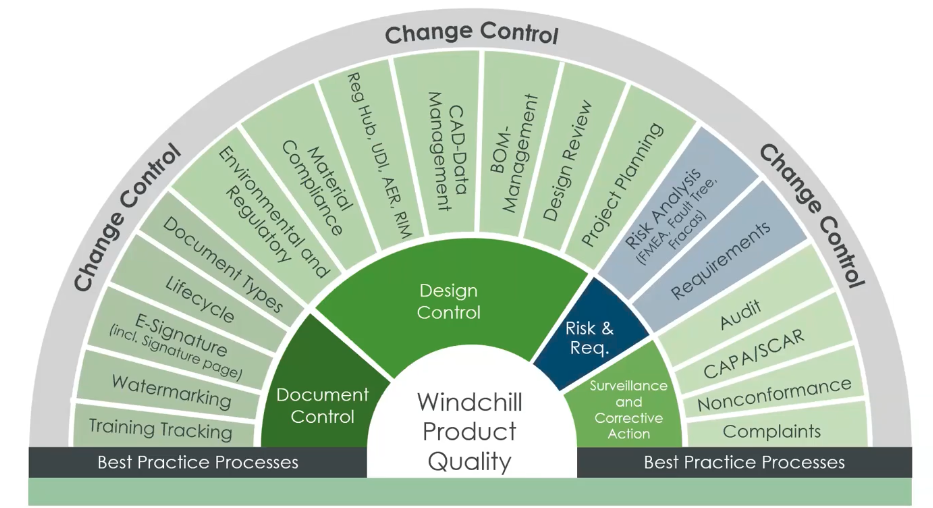
Ultimately, Windchill helps connect physical products to digital twins through a digital thread for tracking and improved management across QMS processes:
- Design and documentation
- Validation
- Regulatory hub
- Manufacturing
- Nonconformance
- Audits
- Maintenance and service
- Customer experience and adverse reporting
- CAPA
- Change management (optional)
Windchill QMS integration enables the generation of a digital thread that serves as the single source of truth for all product information across your organization.
See Windchill QMS in Action
For a demo of how to view these types of tasks within the Windchill interface, watch the Power Hour Day 1 video and skip to 11:30.
Real Impact: Product Traceability
The real impact of an integrated QMS is product traceability. Teams can connect every complaint, nonconformance, CAPA, and audit finding directly to the parts, BOMs, documents, requirements, and change records that define the product.
With this traceability in place, quality events become a closed-loop system: a signal is captured, impact is linked to the exact product configuration, corrective action is executed through controlled change, and effectiveness is verified with clear evidence. This process works to reduce repeat issues, accelerate investigations, and make audit readiness a byproduct of normal work rather than a fire drill.
Ready to Get Started with Windchill Integrated QMS?
NxRev can help you get Windchill QMS set up to deliver real product traceability, not just “better documentation.” Our implementation process connects QMS and PLM, so complaints, nonconformances, CAPAs, and audits link directly to product definition and controlled change. That means faster investigations, stronger audit evidence, fewer repeat issues, and a quality process that drives action rather than chasing context.
Ready for end-to-end product traceability? Contact us for a Windchill QMS assessment or a working demo based on your current process, and we’ll map the fastest path from manual QMS debt to a connected, closed-loop system.
